A whole world,
one tab away.
Choose from nine callings, explore a shared realm, follow sprawling quests, and hunt rare enemies—right in your browser.
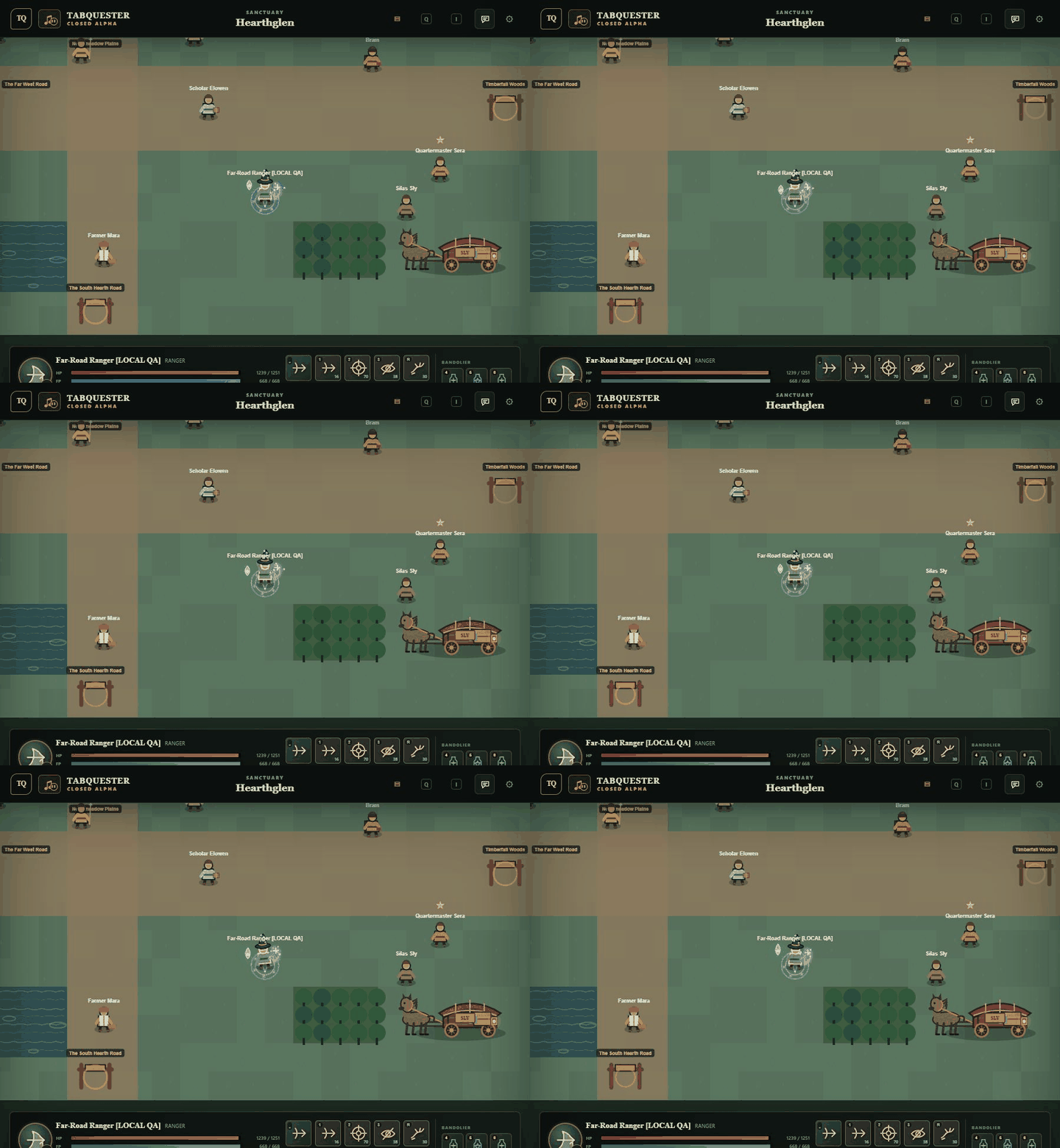
Real scenes from the current build. Choose a glimpse below, use the arrows, or open the large view for a closer look.
Adventurers can turn chat commands into visible emotes for everyone nearby.
CLOSED ALPHA · FULL SPOILERS
This living reference is generated from the current game data. Use it to find quest chains, camp named monsters, verify placeholder cycles, and check whether rewards are behaving as listed.
TABQUESTER DISPATCHES
This is the permanent home for alpha fixes, larger updates, and testing news.
The Lanterns That Would Not Dim is a thirteen-chapter creator chronicle that closes with a group epilogue. The quieter title belongs to its in-world story: rough roads, failed lanterns, careful corrections, and a workshop that keeps a chair ready for whoever arrives next.
Why this tribute? RedGuides gave TabQuester a place to be shared while its world was still a rough map. Community members became some of its earliest adventurers, bringing hands-on playtesting, bug reports, balance notes, and candid feedback that helped these roads take shape. This quest line is our thank-you.
A final case remains. After restoring the four makers' chronicle, groups can challenge Duskclaw, Registrar of the Iron Archive in the eastern Howling Tundra. The oversized black-iron gate machine is far too powerful for an ordinary lone traveler. It represents a small, resilient workshop continuing to build beneath the weight of an older machine while proving that CASE CLOSED can still be corrected to RECORD REMAINS OPEN.
The Record Remains Open unlocks after The First Flame Still Burns. Multiplayer protocol 15 and world layout 18 ship with the registrar; refresh an open game tab before answering its writ.
Fanthobe visits Hearthglen from September through October for a three-part birthday journey at levels 10–15. Gather ingredients along three distant roads, bake his cake, and earn a rare charm for your calling. Its little Birthday Wish heals 10% of your maximum health outside combat, once every six hours, while equipped.
Sly's Hallowhollow Fair opens in October: a temporary zone with four quests for levels 12–20, biting pumpkins, straw collectors, and one customer who refuses to leave. Complete the haunting to become an After-Hours Exorcist. Event dates use UTC; unfinished quests wait for the next season, and anyone still at the fair when it closes returns safely to Hearthglen with their corpse contents preserved.
The Lanterns That Would Not Dim is a year-round, thirteen-chapter adventure from levels 15–30. Find Redd Botwright, Cewtyn Brasshand, Sicren Quill, and Kaenor Hearthmane, follow the work behind the rumors, and recover the full story preserved in the Ledger of Closed Doors. Earn True Original, Keeper of the Flame and a permanent all-class First Hearth Waystone before the chronicle's final group challenge. The waystone opens a six-second gate to Hearthglen outside combat once every 48 hours. Stand still while it channels; movement, damage, or combat interrupts the journey. No expansion purchase is needed.
Shared-world reliability: Fixed issues with shared-world connections, character identification, and access during reconnects and account or device changes.
Class repairs: Wizard basic attacks now cast at range, and Frost Nova, Meteor, and Starfall use spell power. Bear Form applies its stated healing penalty once. Necromancer's Life Siphon and Death Bloom heal from health actually lost after armor, including enemies with little health remaining. Warrior's Challenge now reaches the player coordinating a shared encounter.
Party healing and buffs apply to living nearby companions in the same zone, and a shorter defense no longer cuts an existing longer defense short. Damage-over-time effects retain their own caster's contribution. High-level attacks no longer lose damage to the old shared-world cap, and Arc Lightning's extra targets obey the same range and visibility rules across connections.
Mara Hale at Sablewatch now stocks the corresponding early weapon upgrade for all nine callings. Empty resource bars stay empty when a character reloads, and failed sign-ins preserve the current device's roster. Item cards hide zero-value stat bonuses, and toast messages stack only two high. Refresh your game tab after this update to load the matching world and client.
Rogue, Druid, and Bard join the roster for testing, with nine character slots. Each calling has three starting abilities, seven trainer abilities, and its own optional class trial. 87 new class equipment items are woven through the old world and Far Roads, including shops, named drops, quest rewards, and evolved calling relics. Rogues exploit openings, Druids heal and take wild shapes, and Bards maintain songs for nearby companions. Existing characters remain in place.
Sly and his fellow shard traders now offer three account-wide emote packs for 2 Shards each: Tavern Tall Tales, Dubious Heroics, and Pocket Sorcery. The six familiar emotes remain free; new performances can be used from the Wardrobe or chat commands.
A small retro scenery pass adds campsite details, tent stitching, weathered bridge planks, fishing-hut nets, wrecked timber, and garden color without changing paths or building footprints. Named gear rolls keep their existing drop chances, with a preference for equipment usable by nearby participating callings.
The Far Roads and veteran routes gained ten optional duties and twenty-seven regional creatures, with more deliberate mixed-monster camps, refining work, named hunts, and side rewards. These paths provide level-appropriate alternatives without replacing the main progression rewards; their standouts include new rare equipment and account-wide vanity finds.
Champions of the Old Road sends veteran adventurers back through the legacy regions to hunt their most dangerous inhabitants. Completing the full circuit awards the Champion of the Old Road title and one calling-specific offhand, now covering all nine classes.
A road-tested necromancer has a little optional work for curious travelers on Ember Coast. This new adventure is an in-world thank-you to Kuhle for helping test and shape the Old Road. Every calling is welcome; the rest is yours to discover.
Enemy engagement barks now draw from larger creature-family voices, while new Far Roads monsters and named guardians have lines suited to their camps and duties. Ordinary creatures speak only occasionally; placeholders and named enemies always make their first attack known. A named-sprite audit also restored missing authored appearances such as Meret, Keeper of the First Seal.
Items and quests can now be linked directly in World, Say, Group, or Whisper chat. Choose Link in Chat from an item’s Pack details—or Shift-click it on desktop—and use Link Quest Progress in the journal to attach a read-only snapshot of current objectives, giver, and return location. Recipients can inspect linked item stats or quest progress without accepting anything or changing their own journal.
Group frames now show live same-zone health plus each calling’s resource—Mana, Stamina, Focus, Essence, Conviction, Energy, Spirit, or Melody—with clear low-health warnings. Desktop frames use exact values while phones use compact percentages. Members in another zone retain their name, calling, and location but do not expose stale combat vitals.
Party invitations now keep every adventurer in one confirmed group. Already-grouped players are marked GROUPED in Nearby, expired invitations cannot change an existing party, and competing accepts cannot exceed four members. Any party member can invite a solo adventurer; use Leave Party under Nearby before joining a different group. Brief connection drops reserve a member’s place for up to 90 seconds.
Optional named hunts and the new class trials received a shared-world activation fix. Preparatory objectives must be completed before their challenge is called, and lingering combat effects now remain consistent when the player coordinating a zone disconnects. Refresh your game tab after this update to load the new callings, equipment, and multiplayer changes together. Please send feedback on the new classes and on phone group play.
The Pack’s item-stat inspector now remains in the inventory flow instead of floating over bag slots while the drawer scrolls. Linked cards use the game’s own item catalog for their displayed stats, and the shared-world relay validates their compact payloads and character identity before forwarding them.
Quest offers now show a recommended level range before acceptance and can be declined with Ask Again Later. The same NPC will offer declined work again, and NPCs carrying several duties let adventurers choose which one to discuss. Merchants such as Sly can open their wares without requiring an unrelated quest to be accepted first.
The quest journal now records who gave each duty and the giver’s zone, then clearly identifies where and to whom a completed quest should be returned. This is especially useful for optional Far Roads work that a higher-level character may reasonably skip.
Auto Loot remains the default. Adventurers who turn it off now receive a rolling, non-blocking Field Loot shelf instead of a combat-covering decision dialog. Press L or choose L Loot in the header to review waiting drops, take an item, leave it on the ground for three minutes, or pass it directly to a nearby group member. The shelf can also turn Auto Loot back on—or off—without visiting Settings.
The Field Loot shelf docks like the other interface panels on desktop and rearranges itself for portrait and landscape phones. Today’s pass makes the portrait shelf shorter and gives its header control the same keycap treatment as Q Quests and I Pack, preserving more of the playfield while choices are waiting.
The Pack and Quest Journal now follow that same non-blocking idea. Opening either one reflows the playfield instead of covering it, leaving movement and combat active. On desktop the shelf temporarily takes the usual Chat column; use the persistent C Chat header action or press C at any time to return directly to Chat. That header action remains available beside Field Loot too, and incoming player chat illuminates it with a red unread dot until Chat is opened. Phones use a compact upper shelf in portrait and a side shelf in landscape.
Silas Sly now offers Sly’s Surname Deed for two Shards. It unlocks an account-wide Wardrobe field where one cosmetic last name can be set, changed, or cleared for every character. Other adventurers can see it on character identity displays and world nameplates, while chat and activity messages keep the concise original first name. It never changes the original character name, save identity, or stats; timestamped account saving also keeps newer surname changes from being replaced by an older device.
Stackable merchant supplies, including potions, can now be purchased in a chosen quantity. Far Roads hunting also gained additional level-appropriate class rares across three equipment bands; they broaden field finds without overtaking named loot or the authored rewards at the end of quest chains.
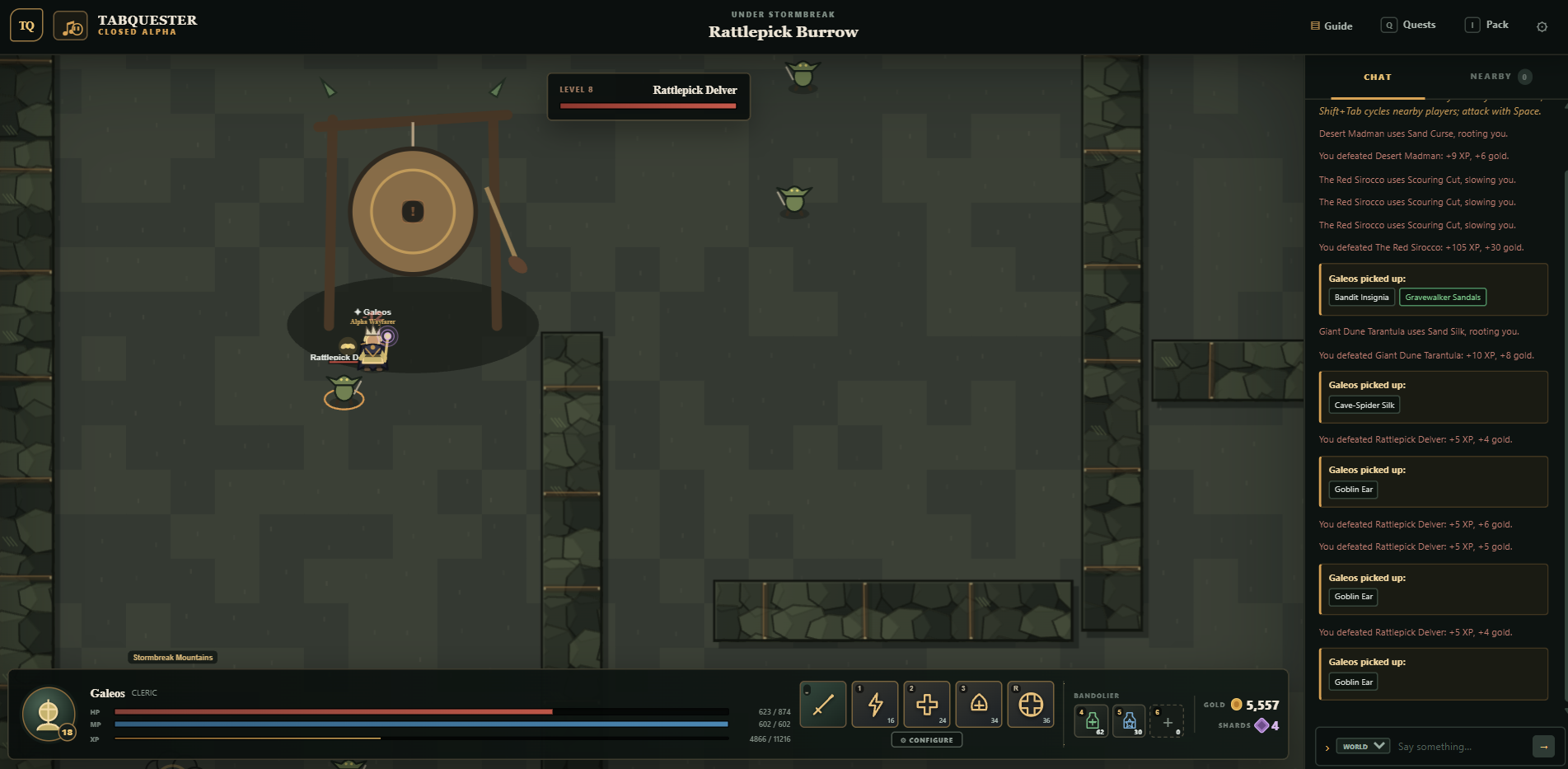
A hostile-objective audit found the western Rattlepick gong was still sitting in its entrance chamber. It now waits beyond the Burrow’s first choke point beside a Rattlepick Gong Guard placeholder, which may rarely reveal Vek, the Gong-Minder.
Some enemies may now greet the beginning of a fight with a short, in-character bark. Listen closely—the road has found its voice.
Anonymous play still needs no login and keeps its roster in the current browser. Adventurers can create an account immediately or later to claim that existing roster, then sign in by username or email on another computer or phone. All six closed-alpha character slots remain intact, and this is still an additive, no-wipe update.
Email verification and password recovery are now live. The account panel makes the already-sent verification message prominent, labels the follow-up action Send again, and gives clearer confirmation before returning to the game. Different characters on one account may adventure at the same time, while opening the same character twice cleanly hands its active session to the newest tab.
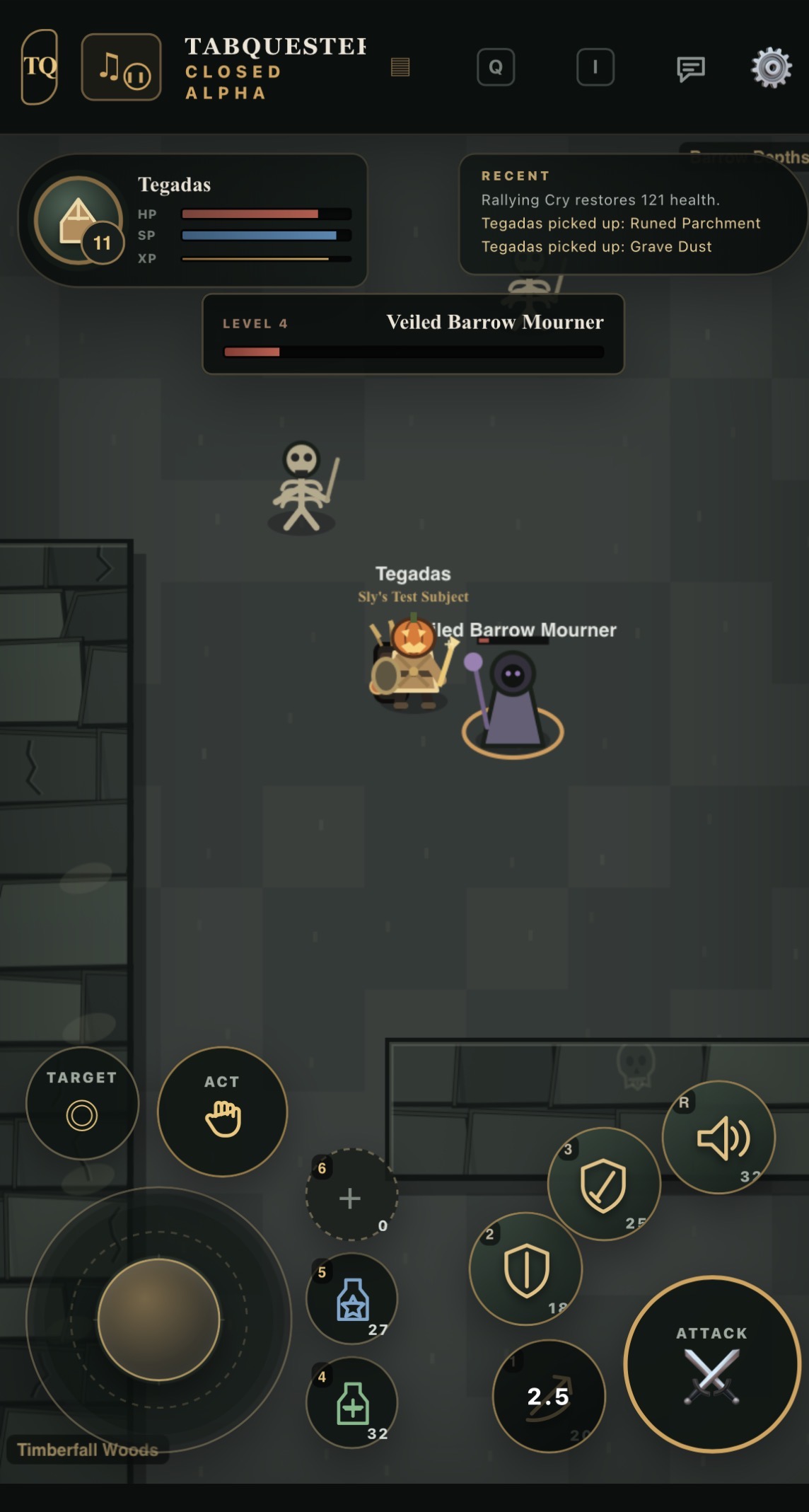
Phones and touch tablets are detected automatically and receive a purpose-built HUD: analog movement, a curved thumb-reach combat fan, persistent bandolier buttons, compact character and target panels, a short recent-message log, and fitted chat, Nearby, party invitations, dialogue, inventory, quests, and field notices. Movement and abilities accept separate simultaneous touches, so ranged callings can keep moving while firing. Mobile interaction hints identify the ACT hand instead of asking touch players to press E.
Portrait and landscape now arrange their HUD pieces independently. The mobile header, party strip, target panel, toasts, zone labels, and character information were tightened or repositioned to preserve the playfield. Safari flyouts respond reliably after rotation, drawers follow the visible viewport, and touch actions suppress text selection, page scaling, and accidental zoom.
Mobile rendering now caps high-density canvas work at a phone-appropriate resolution, reducing the number of pixels drawn without changing desktop quality. This should improve frame pacing on high-DPI phones while retaining crisp interface art.
Shared-world recovery received another reliability pass for multiple phones and other reconnecting devices. A stalled zone leader now yields control automatically, returning players accept fresh zone state correctly, and frozen monsters or attacks should recover without requiring everyone to leave. Online presence continues to collapse stale duplicates into one real character.
Travel through the western frontier now keeps its compass sense: Hearthglen's west road enters Alderwild from the east, and Alderwild's route to Warden's Divide runs south into that region's north edge. Ordinary sell-junk drops across the Far Roads were reduced by roughly a quarter; quest materials, consumables, equipment, named-enemy drops, and authored loot pools were left alone.
Quest and economy cleanup preserves Prospector Reed's and Warden Vale's delivered-material credit, lifts several overly cheap trade goods above one gold, gives the Far Roads clearer Guide flyouts, and corrects northern creature materials. Existing saves carrying the resulting map or dispatch repair their hand-in credit automatically.
Regional rocks, tomb and goblin walls, the Barrow Abyss wardstone library, the White Between's growths, Blackreed's Warcamp gate and signal tower, and many older quest interactions gained authored scenery. Town buildings and Sly's horse-drawn shops received their own texture pass, including consistent SLY badging.
The vanity wardrobe gained Viking, wizard, and steel headwear; ember-touched weapons; class-flavored ground effects; and several surprises. Longer preview sessions no longer stop responding. The Field Guide now opens with a clearer introduction, current controls, a gallery of real current-build scenes, and rolled-up older dispatches that do not pull readers away from the section they are viewing.
Mobile movement now uses an analog joystick for natural diagonals and fine corrections. iOS Safari touch controls suppress selection, callouts, and accidental zoom, while ACT uses a dedicated interaction symbol instead of a selectable letter.
The interface now recognizes a compact touch device when the game opens or rotates instead of carrying a saved desktop magnification onto the phone. Mobile chat and Nearby live in a fitted top-bar flyout, party invitations open directly to their accept controls, and group members use a compact scrolling party strip whose names cannot cover its Follow and Whisper buttons.
Duplicate reconnect sessions now resolve to one active character, zone authority transfers cleanly, and online statistics deduplicate the remaining presence. This addresses the frozen-monster and ineffective-attack state seen after leveling or reconnecting on a phone.
Hosted rosters can now be claimed in place with a familiar username, email, and password. The same account and all six alpha character slots open on phones and other computers, with email verification and password recovery available when needed. Each device keeps its own login session and different characters may be played simultaneously. Opening the same character twice still hands control to the newer session so its save cannot split.
Regional rocks and dungeon walls gained layered, place-specific art. The Barrow Abyss now has a chained living library and wardstone reliquary; Blackreed gained a rock-framed Warcamp entrance and a rickety Reedwatch signal tower; the White Between and Doorless Country gained walkable ooze and tendril growths.
A second legacy-zone pass gives Rattlepick’s alarms timber gong rigs, the Royal Sepulcher a sun-seal court, the Ashen Crown smoking ritual vents, Ironjaw three distinct sabotage mechanisms, and Admiral Deadwake a broken cabin around his final log.
Reed’s survey exchange and Vale’s wardstone relay now preserve delivered-material credit after consuming the hand-in. Saves already carrying the resulting map or dispatch repair themselves on load. Familiar early trade goods also received a modest merchant-value increase.
The Field Guide now gives the Far Roads separate Westward, Snowbound South, and Elsewhere flyouts. This is an additive, no-wipe polish update; existing characters and progression remain in place.
Silas Sly has lately taken to speaking—very quietly—of roads beyond the barricades: snowbound reaches, giant-held passes, wars among beings best not named too loudly, and places that may not entirely agree with reality. Asked how he knows, Sly only smiles, dusts unfamiliar snow from one boot, and says he may know “a small way around a large inconvenience.” His Shard-bought charter opens the western and southern passages for the whole account; buy it once and every character may travel them.
The west crosses Alderwild, Sunscar Mesa, Warden's Divide, and Stonewake Range before reaching full-service Briarfast. The snowbound south crosses Saltfrost March, Mirrorfrost Basin, and Shiverglass Deeps before reaching full-service Rimecross. Both towns are deliberately distant enough to reward banking, binding, training, and making a new home there.
Higher roads continue through the One-Eyed Delve, Demiurge Margin, Exaltscar Glacier, the White Between, and the Doorless Country. New harpies, manticores, wights, frostglass crawlers, horrors, giants, and cyclopes mix with familiar creature families. Giants and cyclopes now use substantially larger purpose-built character art.
Seven new linked duties use world interactions, shared gated bosses, prerequisites across both routes, and a final destiny-bound calling quest. Completing it evolves the Warrior, Cleric, Wizard, Ranger, Necromancer, or Paladin relic earned from the earlier eastern class trial.
Every class gained disciplines at levels 38 and 46 with more distinct play: challenge and giant-breaking, sustained cleansing heals, Blink and chaining lightning, camouflage and distance shots, health-for-Essence sacrifice and crowd drain, or charging and sacrificial group recovery.
Thirty-one new items bring the catalog to 260. The additions include shared rares and quest materials, catch-up named equipment for the newer callings, and six final destiny relics—one each for Warrior, Cleric, Wizard, Ranger, Necromancer, and Paladin. Shared named-loot tiers remain evenly represented across all six classes.
A world-wide named audit now guarantees at least one rare encounter and a tier-appropriate shared loot table in every combat zone. Meret guards the Sable Tomb's first seal, Grinbark laughs from Alderwild's deep grove, and Stonewake's bone mound and manticore den gained their own named placeholders. Burning Jungle, Ember Coast, Emberfall Peak, the northern forts, and the Far Roads now use authored shrines, camps, lairs, bridges, hazards, and activation scenery instead of lonely interaction symbols.
Settings now include an early optional mobile-play foundation: an on-screen movement pad plus targeting, interaction, and attack controls. To turn it on, enter the world, select the ⚙ Settings button at the upper right, and switch on Mobile controls. The bricks are in place and playable, but sizing, placement, and feel are expected to change with tester feedback.
Emotes are now their own visible bit of character play: `/wave`, `/bow`, `/cheer`, `/laugh`, `/dance`, and `/sit` animate for nearby adventurers. Banks use exact deposit and withdrawal range selectors, and quest-material warnings name the requesting giver and quest.
Shards are account-wide and remain safe on death. Every frontier town has a Sly-style Shard peddler and broader regional merchant stock, while chaplains can call a corpse for gold or two Shards. Silas also offers a modestly massive gold bag.
Live-update note: local testing has gone well. This is an additive, no-wipe update; existing characters, banks, unlocks, Shards, and quest progress remain in place.
The soundtrack now has a strong catalog of zone-fitting music across the old world and the new roads. Individual tracks and placements may still change as the world grows, but every zone now has music chosen to suit its character.
New and existing content will keep being tested, refined, and expanded with quests, items, foes, and world details. The continued tester feedback has been excellent—please keep it coming.
Mara's Quiet-Bone Locket, its awakened forms, the Hale family sword, and other story-critical relics are now marked Destiny-bound. These items may be kept in the bank, but they cannot be traded and merchants will recognize their importance instead of buying them. A banked relic remains safe, though it must be withdrawn when a quest calls for the item to be carried.
Discarding a destiny-bound relic now requires a deliberate confirmation. The relic passes into chapel custody rather than disappearing forever; the Chaplain can restore it through a one-Shard ritual. If a corpse decays while holding one of these relics, the same protection carries it to the chapel automatically.
Adventurers who would rather retrace their steps may repeat the relic's original quest for a replacement without receiving its gold or experience again. Only one copy of each destiny can remain with a character, and awakening a relic cleanly replaces its earlier form.
Quest journals now recount collection materials from the adventurer's actual pack. Selling, trading, turning in, destroying, or losing a needed material immediately lowers the displayed total. Other unique story rewards receive clearer descriptions and an extra warning before sale while remaining the player's choice to keep or sell.
The shared-world server now explicitly assigns each zone's monster authority and supplies fresh state on request, removing a client-side authority disagreement that could leave one party member seeing frozen monsters or missing attacks. Brief reconnects hold a party member's place for ninety seconds instead of dissolving a two-person group.
Ground loot is now synchronized through the zone service, including expiry and one-player pickup claims. Eligible same-zone party members receive defeat credit for every matching open quest, while quest-item drops are personally copied to every party member who still needs that objective rather than only the killing character.
Direct gifts now support gold and selected quantities from item stacks. Two-sided trades also accept item quantities, and scaled trade, merchant, service, and quantity windows remain inside the visible screen. Repeated field messages refresh cleanly without ambiguous multipliers, Stormbreak's edge label respects interface scaling, and the Pack keeps a compact Wardrobe control with a pinned item-stat inspector.
Silas's recovery and focus cases now cost eight Shards and contain four party-wide expedition tonics. Using a bottled Gate announces the destination to the party and gives each nearby member a persistent accept-or-stay choice before travel.
Quartermaster bounties remain unlimited while now tracking lifetime contributed items. Every fifty items awards one testing Shard; recognition at 100, 250, 500, and 1,000 items unlocks titles, a name badge, a field cloak, and a class-specific requisition weapon.
Silas expanded both permanent and Hallowtide vanity shelves with regional cloaks, a feathered Warden cap, a goblin tool badge, a crooked witch hat, Ravenwing mantle, Candle Crown, pumpkin badge, and three seasonal titles.
Silas Sly's experimental vanity shelf now offers account-wide crowns, packs, cloaks, weapon finishes, ground marks, movement trails, titles, and companions for Shards. Every cosmetic can be previewed on your current character before purchase, none carry combat stats, and each character can arrange unlocked looks in the V Wardrobe. A limited Hallowtide preview adds a pumpkin helm, gravefog trail, and witchlight companion.
Gilded Arms now traces each calling's actual weapon instead of adding a generic staff, Violet Focus uses three compact magical rings, and the goblin pack, Duskroad Cloak, chest wrap, and Sable Sun Disc have stronger silhouettes. Silas also sells an inexpensive Sly's Test Subject title so purchased-title display can be tested directly.
The Long Warden's Relay and The Sword Remembers now award exclusive titles, including retroactively for adventurers who already completed them.
The regional soundtrack now runs continuously from Hearthglen through the eastern frontier and Ironjaw Castle, including unique themes for both deeper Barrow floors, Stormbreak, Rattlepick Burrow, the Sable regions, Blackreed, and Stonejaw. Press M or use the note-and-play control beside the TabQuester mark to stop or resume it immediately; music has its own persistent setting separate from combat sounds.
Completed quest-chain steps now roll up to a compact title card and expand on demand, preserving the full story without crowding active objectives. Edge entrance labels also choose separate lanes and reserve the bottom HUD area, preventing neighboring destinations from covering one another or disappearing behind the action bar.
The Broken Warden Seal now continues through Stormbreak's alarms, the Barrow's living library, the Royal Sepulcher, Reedwatch, and Ironjaw Castle. A second campaign runs from Northmeadow through the Ashen Crown, Lost River, Burning Jungle, Ember Coast, Deadwake's Wreckage, and Emberfall Peak.
Quest journals may now be abandoned without permanently losing the duty: progress resets, quest-only materials belonging to that duty are removed, and the original giver can offer it again. Class trials no longer appear in the wrong calling's journal, and quests now support visit, conversation, and world-object objectives alongside hunting and collection.
Chief Urgan is no longer an ordinary permanent camp. Edrin's recovered memory summons him as a shared Ironjaw quest encounter; restoring the Worldedge wards similarly calls Vaelora. The shared-world service owns encounter activation and cooldowns so every player in the zone sees the same boss.
Creature-family loot has been separated: living books yield runed parchment, ink creatures yield abyssal ichor, crypt slimes yield ooze, spiders yield silk, bats yield membranes, wisps leave mirelight residue, and bog serpents no longer carry crocodile scales. Ashen Crown and Cinder Jungle goblins now share Sootblack Goblin Toolkits.
Ranger, Necromancer, and Paladin gained signature direct drops from named foes across the early, frontier, and late-game roads. New quest objects and NPC duties are documented throughout the live-generated field guide.
Centered field notices now stop at three visible messages and combine identical bursts instead of climbing across the play area. Class-locked and progression-gated NPCs also repeat their exact requirements in these notices so important dialogue is not lost in combat chat.
Stacked items can be sold with a quantity selector, while Shift-click sells an entire non-bounty stack. Quartermaster trophies identify their greater town value, support bulk bundle turn-ins, and remain repeatable without a lifetime limit.
Item cards now state their class requirement consistently across inventory, buying, and selling. Legacy unrestricted equipment uses stable item-appropriate artwork instead of inheriting the viewing character's weapon icon.
The Long Warden's Relay may now be accepted solo while remaining group-recommended and shared when grouped. Loose Ends opens directly after Hearthglen's first patrol, deep named-monster gear rolls received a modest increase, and portal labels now stay on-screen at edge entrances such as the Northmeadow road.
Accepting a quest now presents a compact excerpt from its giver with a direct link to the relevant journal entry. The complete conversation remains in chat with a distinct quest treatment and its own journal link, keeping important instructions visible without adding another tall notice.
Ranger's free Bow Shot now has a shorter effective reach and bow artwork, while Quick Shot and Binding Arrow retain their full range. Idle monsters choose stable roaming destinations, return home with a buffered leash, and hold their facing through small direction changes instead of vibrating at wander boundaries.
The shared-world service now retains authoritative living-monster positions when a zone empties. Re-entering within five minutes resumes that zone where its creatures were last roaming; after five empty minutes the zone sleeps and wakes with a fresh population. Cloudflare stores only throttled snapshots, so empty zones do not run simulation timers.
Combat targeting now keeps neutral and grouped players out of hostile auto-targeting. Tab cycles visible enemies, Shift+Tab cycles nearby players with party members first, and hostile actions only consider another player when both sides are PvP flagged. A visible Configure control replaces right-click as the required path for changing action and bandolier slots, while closable configuration panels now layer above party frames.
The Nearby tab now calls attention to newly arrived players and pending invitations. Incoming party invitations remain centered with a direct link to Nearby until they are accepted, declined, or withdrawn.
Bram now carries an affordable weapon, offhand, armor, and class-specific headpiece for every calling. His buy list places supplies and the current character's equipment first, with explicit class labels across the original Warrior, Cleric, and Wizard starter sets as well as the newer callings.
Silas Sly now stocks a high-end Shard shelf with bulk Greater Mending Tonics, Greater Focus Draughts, veiling and Gate-potion cases, experience-elixir reserves, and a final 32-slot pack upgrade.
Ranger, Necromancer, and Paladin are now freely selectable for alpha testing. Each arrives with a distinct resource, ranged or melee combat profile, three core actions, and five trainable disciplines spanning levels 6 through 30.
Named-loot pools and every class-choice quest now cover all six classes. Trailmaster Ryn, Vesra, and Oathkeeper Solan also offer exclusive trials in Rattlepick Burrow, the Sable Tomb, and the Royal Sepulcher, each awarding a new class-bound rare.
A same-day parity pass gives every class exactly one exclusive trial. Orren's Stonejaw history is now open to everyone, while Sister Iri and Arcanist Neme offer new Cleric and Wizard trials with their own class-bound rare rewards.
The temporary alpha character limit is now six, giving every tester room to keep one adventurer from each playable class. The intended post-alpha limit remains three.
All 25 non-safe combat regions now have more room: thirteen outdoor maps are 1.6 times wider and taller, while twelve dungeons and hostile outposts are 1.35 times wider and taller. Towns and friendly outposts remain compact.
Ordinary monster placements have expanded with the terrain, including dedicated hunting pockets near all four edges of each enlarged region. Named camps remain unique, marked roads grant a modest movement bonus, and existing characters, bind points, and corpses migrate automatically to equivalent locations.
A multiplayer integrity repair separates incompatible map versions, prevents remote players and monsters from smoothing through solid walls, and requires clear line of sight for targeting, hostile abilities, and authoritative hit approval. Reconnected or duplicate-tab sessions for the same character now resolve to one visible adventurer instead of leaving a temporary copy behind.
Public-facing branding now centers the TabQuester name while the wider world's subtitle remains under review. Existing place names and internal save identifiers remain stable.
Three new side routes give adventuring parties alternatives when a region is heavily hunted: Rattlepick Burrow beneath Stormbreak, the mummy-filled Sable Tomb and its deeper Royal Sepulcher, and the orcs' Blackreed Warcamp.
Azem, King Beneath the Sun, has withdrawn from the open desert to the sunless throne at the bottom of the Sable Tomb. New goblin, mummy, and frontier-orc camps continue to award the existing Warden trophies.
Moved notices lower into the play area and made them more translucent. Timed icons beside the player vitals now identify beneficial spells, veiling, bonus experience, roots, snares, and damage-over-time effects.
Empty bandolier slots now open a consumable picker. Loot lines identify who received each item, stand out in chat, and open your copy directly in the pack; newly looted items briefly pulse. New parties announce their default round-robin item loot and automatic gold split. Quartermaster bundles show required and owned totals more clearly, Trainer Rowan signals when training is available, and Loose Ends now points through the guarded bandit camp toward Stormbreak.
Added character-select music and a manual music control, speech bubbles, clearer chat colors, prominent whispers and notices, party XP bars, recent group chat, pulsing quest markers, improved portal visibility, and scrolling merchant lists.
Group XP now gives lower-level adventurers a restrained catch-up share, nearby party members receive shared quest drops, named monsters no longer vanish when another player enters, Bram stocks testing Shards, Silas sells a temporary XP elixir, and Warden Ainsley offers a new level 5 quest. Desert travelers may also reach Sablewatch Outpost while the lands beyond remain level-gated.
Added the current effects of Might, Vitality, Wisdom, Intellect, Armor, and special equipment modifiers to the field manual. Thank you to our testers for catching that these were not explained anywhere.
Added practical instructions for controls, combat, grouping, chat, shared rewards, trading, corpse recovery, progression, town services, and PvP.
Added automatic interface sizing and manual 100%–200% scale options for high-resolution and ultrawide displays. Thank you to everyone who called out the hard-to-read text right away.
TabQuester opened its shared browser world to invited testers. The first public testing journey begins here—thank you for helping shape it from the start.
Alpha reminder: Everything listed here can change. Current updates preserve tester characters and the new account migration claims their existing cloud save in place; the final launch-retention policy will be announced before release. Named percentages roll each time a camp respawns, and a rare spawn does not guarantee its rare direct item.
A practical introduction to your first adventure, the controls, and the multiplayer systems currently available in the alpha.
Create a Warrior, Cleric, Wizard, Ranger, Necromancer, Paladin, Rogue, Druid, or Bard. Each character saves separately and begins equipped for its class role.
Find Warden Ainsley in Hearthglen and press E or tap ACT to accept your first work on the Timberfall road.
Click a foe or press Tab to cycle hostile targets. Use Space for a basic attack and your action keys for class abilities.
Open the journal with Q, return to the quest giver when ready, use I for equipment, and open the account-wide Wardrobe with V.
Press E or tap ACT at zone entrances to travel. Marked roads are slightly faster, while harder regions, hunting pockets, named camps, and better equipment wait farther from town.
Mobile mode turns on automatically for touch-first phones and tablets. You can override detection from ⚙ Settings at any time, and the compact L Loot header control opens waiting field drops.
Move through the world
Interact with NPCs, corpses, ground loot, and zone entrances
Select a player or enemy directly
Cycle visible hostile targets
Cycle nearby players, prioritizing party members
Use your class's basic attack
Use configured class actions
Change action or bandolier slots; right-click remains an optional shortcut
Use assigned bandolier consumables
Open your pack, quest journal, Field Loot shelf, and Wardrobe
Turn character-select or zone music on and off
Focus the chat input
Accept a pending party invitation
Perform visible emotes; use /emotes for the complete list
Stats increase automatically with your class and level, while equipped items add their listed bonuses. Might supports weapon callings and martial resource pools; Wisdom and Intellect support caster resources, spells, healing, and hybrid actions.
Raises Weapon Power for ordinary weapon attacks and weapon-scaling actions used by Warriors, Rangers, Paladins, Rogues, and other weapon users.
Each point adds about 1.35 Weapon Power. It also adds 2 maximum Stamina, Focus, Conviction, or Energy to martial callings.Raises maximum health for every class.
Each point adds 8 maximum HP.Strongly expands caster resources and leads spell damage and healing for Druids and Bards. It also strengthens a Druid's Prowler attacks.
Each point adds 3 maximum Mana, Essence, Spirit, or Melody to caster callings. It adds about 1.55 Spell Power for Druids and Bards, or 0.65 for the other callings.Leads Spell Power for Wizards, Clerics, and Necromancers, while providing secondary spell strength to Druids and Bards.
Each point adds about 1.55 Spell Power for the original callings, or 0.65 for Druids and Bards. It also adds 2 maximum Mana, Essence, Spirit, or Melody to caster callings.Reduces damage from ordinary monster attacks. More always helps, but additional points provide diminishing returns.
Armor does not increase HP and currently does not reduce damage-over-time effects.Warrior: favor Might for offense, then Vitality and Armor for survival.
Cleric: Wisdom gives the deepest mana pool; Intellect currently gives more raw healing and spell damage per point.
Wizard · Arcanist: favor Intellect for damage, with Wisdom for additional mana and secondary spell power.
Ranger · Skirmisher: Might raises bow damage and maximum Focus; Vitality and Armor provide room to survive when enemies close the distance.
Necromancer · Gravebinder: Intellect leads spell and drain damage; Wisdom adds more Essence and secondary Spell Power, while Vitality supports life-siphon play.
Paladin · Oathguard: Might supports weapon damage and Conviction, Vitality and Armor reinforce the front line, and Wisdom or Intellect strengthens healing and spell-scaling disciplines.
Rogue · Opportunist: favor Might for knife damage and Energy. Strike distracted, controlled, or badly wounded foes for stronger openings; use poison, Hamstring, and Evasion to survive close combat.
Druid · Wildkeeper: Wisdom leads nature spells, healing over time, and Prowler strikes. Bear adds health and armor at the cost of casting strength; Prowler trades armor and healing for faster melee. Vitality helps both forms survive, and Intellect supports your spells.
Bard · Roadsinger: Wisdom strengthens notes and restorative songs; Intellect adds secondary spell strength. Keep allies within eight strides, maintain one song at a time, and watch its Melody upkeep. Encore briefly layers your previous song, while Grand Finale rewards a sustained performance.
Special equipment modifiers: Run Speed increases movement by the listed percentage, and Orc Bane increases all damage dealt to orcs by the listed percentage. Might expands martial maximum resources; Wisdom and Intellect expand caster maximum resources. Resource regeneration is currently fixed by combat state rather than stats.
Open Nearby and choose Invite, or use /invite NAME. On phones, the speech-bubble button opens the fitted Chat and Nearby panel. Invitations can be accepted there or with G. There is no level restriction.
Press C to return to Chat at any time, including while the Pack or Quest Journal is open. Use the selector beside chat to switch between World and Group. Direct messages can be started from Nearby or a party frame.
/p MESSAGE or /party MESSAGE/w NAME MESSAGE or /tell NAME MESSAGE/wave, /bow, /cheer, /laugh, /dance, and /sit perform visible nearby emotes/help lists the current commandsEnable PvP in Settings or type /pvp. A crossed-swords marker identifies flagged players, and combat is possible only when both players have PvP enabled.
Equipped items live in their equipment slots instead of using pack space. Click an empty bandolier slot—or right-click an assigned one—to choose a consumable directly. Stackable merchant supplies can be purchased in a chosen quantity.
Death removes up to 15% of the current level’s experience without deleveling. Carried gold, pack items, and equipped gear remain on your corpse; Shards remain safe in the account-wide purse shared by every character.
Warriors anchor the front line; Clerics restore and protect; Wizards deliver ranged spell pressure; Rangers control distance with bows; Necromancers drain and ward; and Paladins combine armored melee with party protection and healing.
Rogues exploit openings with knives and poison. Druids blend nature magic, healing over time, and Bear or Prowler shapes. Bards maintain songs for nearby companions and time their Encores and Finales around the fight.
Merchants buy and sell, bankers protect items and gold, trainers teach class actions, and chaplains handle binding and corpse calls. Quest items can be banked.
Story order, acceptance requirements, objectives, turn-ins, and current rewards.
Journal control: Quest offers show a recommended level range and may be declined without losing them; ask the original giver again whenever you are ready. Active quests can also be abandoned from their journal card and accepted again. The journal names the giver, their zone, and the return destination; abandoning resets progress but preserves handoff items earned from an earlier completed quest.
Every current named spawn grouped by zone, including its placeholder, spawn chance, respawn, abilities, and direct drops.
In addition to direct drops, eligible named monsters roll their pool tiers separately. A successful tier awards one random item from that tier, potentially for any class.
THE PEOPLE BEHIND THE FOOTPRINTS
RedGuides community gave TabQuester a place to be shared while the world was still taking shape. Its members became some of our earliest adventurers, bringing hands-on playtesting, bug reports, balance notes, and candid feedback that made these roads better. The Lanterns That Would Not Dim is our thank-you—and a tribute to a resilient community that keeps building, teaching, returning, and leaving room for whoever arrives next.
A special thanks to Kuhle for testing multiple classes and taking the Old Road all the way to its endgame. To everyone exploring, reporting, and returning for one more adventure: thank you.
YOUR FIELD NOTES ARE READY
Put the guide to work, then bring bugs, balance notes, and recommendations back to the testing community.